
Aquarium Substrate Calculator
Enter your tank’s footprint and the depth you want, choose the substrate, and the calculator tells you the volume, the approximate weight, and how many bags to buy. It handles sloped beds that are deeper at the back — the classic planted-tank layout — and works in inches or centimetres, pounds or kilograms.
- Free to use
- No sign-up
- Runs in your browser
Aquarium substrate calculator
Aquarium Setup & Care Pack
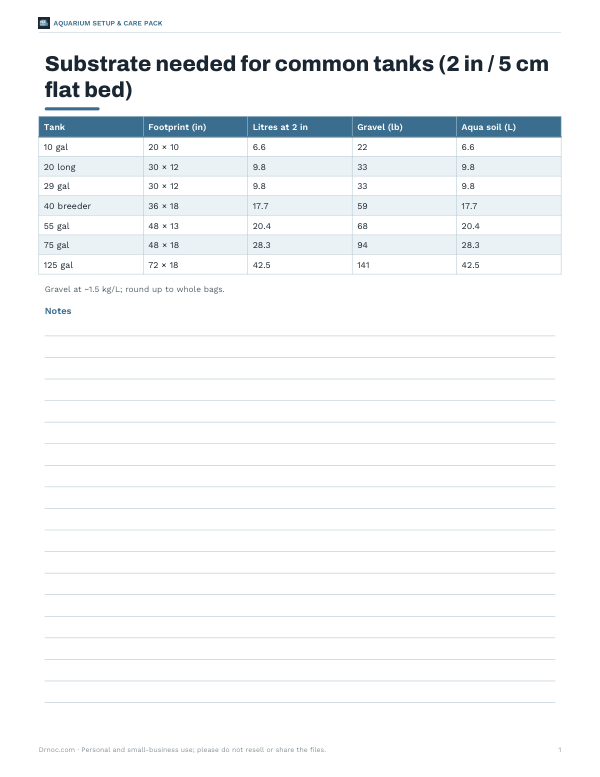
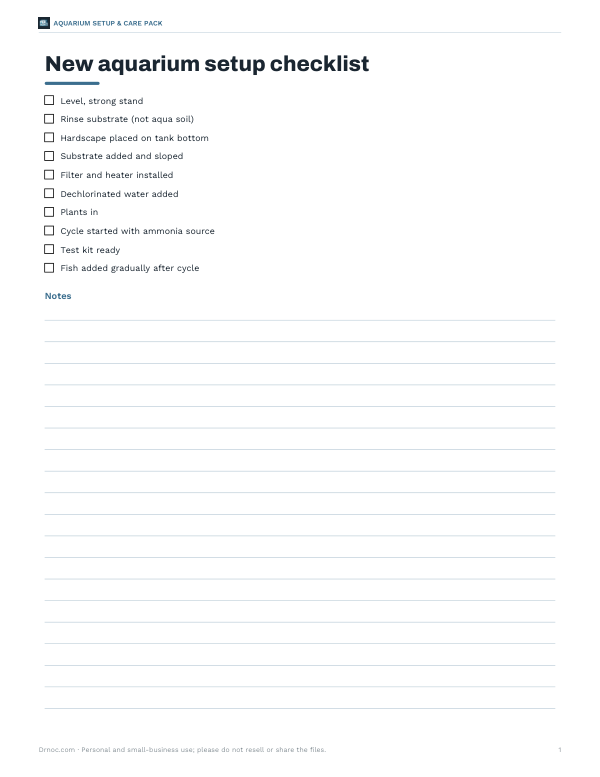
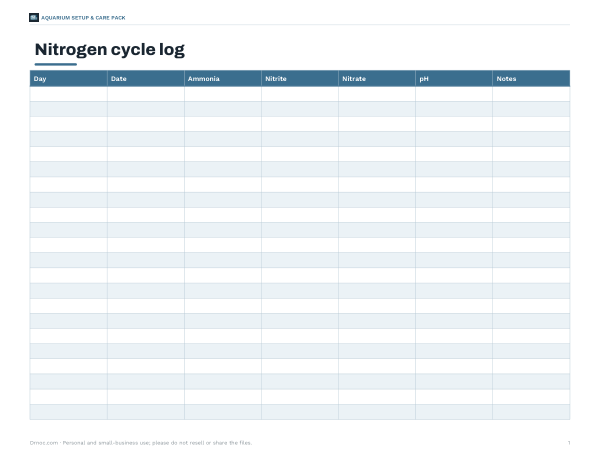
Printable substrate and tank size reference, a new tank setup checklist, a nitrogen cycle log and an Excel water parameter tracker.
- Substrate reference (PDF/XLSX)
- Setup checklist (PDF, DOCX)
- Cycle log (PDF, DOCX, XLSX)
- Parameter tracker (XLSX)
Formats: PDF, XLSX, DOCX. Instant download after payment (link valid 72 hours, up to 5 downloads). AI-assisted: the templates were drafted with AI help and reviewed and laid out before publishing.
$3.00 USD, one-time 4 files · about $0.75 each
- Instant download
- 7-day refund
- Secure checkout by Stripe
7-day money-back guarantee. Full refund within 7 days of purchase, even after you download.
Free sample: New Tank Setup Checklist (PDF, 53 KB)
Full refund within 7 days — see the refund policy and license.
Free printables
Single sheets you can print right now, no sign-up. The full pack adds every sheet in one download plus the editable files.
 Printable Aquarium Water Parameter Tracker
How much substrate do you need?
Substrate volume is simply length × width × average depth. A 36 × 18 inch tank with a bed sloping from 1.5 inches at the front to 3 inches at the back has an average depth of 2.25 inches: 36 × 18 × 2.25 = 1,458 cubic inches, or about 23.9 litres. Gravel weighs roughly 1.5 kg per litre, so that is around 36 kg (79 lb). Aqua soils are lighter, about 1 kg per litre, and are usually sold by volume, so the calculator also shows litres.
Recommended depths
| Setup | Typical depth | Why |
|---|---|---|
| Fish-only, gravel | 1.5–2 in (4–5 cm) | Enough to anchor decor; easy to clean |
| Planted tank | 2–3 in at front, 3–4 in at back | Room for roots; slope adds depth |
| Sand for burrowing fish | 2 in (5 cm) | Loaches, gobies and eels sift or burrow |
| Shrimp tank with aqua soil | 1.5–2.5 in | Buffers pH for many shrimp species |
| Cichlid / reef-style | 1–2 in crushed coral or aragonite | Buffers hardness and pH upward |
Very deep sand beds can trap gas pockets if not stirred or kept by burrowing animals; very shallow gravel does not hold rooted plants.
Choosing a substrate
| Substrate | Pros | Cons |
|---|---|---|
| Gravel | Cheap, easy to vacuum, many colours | Food can fall into gaps; not ideal for delicate bottom dwellers |
| Sand | Natural look, safe for burrowers | Can compact; fine sand clouds when disturbed |
| Aqua soil | Nutrients and pH buffering for plants and shrimp | Breaks down after a few years; can release ammonia at first |
| Crushed coral / aragonite | Raises hardness and pH | Not suitable for soft-water fish |
| Fired clay | Porous, good for plant roots | Light, can float when new |
Worked example
A 40-gallon breeder tank measures 36 × 18 inches. For a planted layout sloping from 1.5 to 3 inches, the calculator gives about 23.9 litres. With aquarium gravel at about 1.5 kg/L that is around 79 lb — four 20-lb bags, or five if you want a little spare. With aqua soil at about 1 kg/L, the same bed needs about 24 litres, or three 9-litre bags.
Adding substrate to a tank
- Rinse gravel and sand until the water runs mostly clear (do not rinse most aqua soils — follow the maker’s instructions).
- Place heavy rocks directly on the tank bottom first, so burrowing fish cannot undermine them.
- Add substrate, building the slope from front to back.
- Put a plate or plastic bag on the substrate and pour water gently onto it to avoid clouding.
- Plant after the tank is partly filled.
- Let the tank cycle before adding fish; aqua soils may release ammonia for a few weeks.
Sloped beds and terraces
Sloping the substrate up toward the back creates depth and perspective and lets you use larger plants at the back. Over time, fish and water movement flatten slopes; rocks, wood or hidden barriers hold terraces in place. For the calculation, use the average of front and back depths.
Cleaning and maintenance
Vacuum gravel lightly during water changes to remove waste without stripping beneficial bacteria. For sand, hover the siphon just above the surface. In planted tanks, avoid deep vacuuming around roots; plants and bacteria process much of the waste. Replace or top up aqua soil when it breaks down into mud or loses its buffering effect — often after two to four years.
Substrate and water chemistry
Substrate can change your water. Inert gravel and sand have little effect. Aqua soils usually lower pH and hardness, which suits many plants, shrimp such as Caridina, and soft-water fish. Crushed coral, aragonite and some decorative gravels contain calcium carbonate that raises hardness and pH — good for African cichlids and livebearers, but not for soft-water species. Test a handful of unknown gravel by dropping vinegar on it: fizzing means it contains carbonate and will harden the water.
Mixing and layering
Many planted tanks use a nutrient-rich layer under a cap of inert gravel or sand: for example 1 inch of aqua soil or root-tab-enriched base topped with 1–1.5 inches of gravel. Calculate each layer separately with its own depth and density. Keep fine sand on top of coarser gravel, not the other way round, or the sand will sift down over time. A strip of sand at the front with gravel behind can be separated by rocks.
Metric quick guide
For metric tanks, multiply length × width × depth in centimetres and divide by 1,000 to get litres. A 90 × 45 cm tank with a 6 cm average bed needs 90 × 45 × 6 ÷ 1,000 = 24.3 litres of substrate, or about 36 kg of gravel.
Privacy
The calculator runs in your browser and stores nothing.
Frequently asked questions
How much gravel for a 20-gallon tank?
A 24 × 12 in footprint at 2 in deep needs about 9.4 L — roughly 31 lb of gravel.
What is the rule of thumb for aquarium gravel?
About 1–1.5 lb per gallon gives 1–2 inches in many tanks; calculating by footprint is more accurate.
How deep should substrate be for plants?
About 2–3 inches, deeper at the back.
Is aqua soil sold by weight or volume?
Usually by volume in litres; use the litres result.
Does sand weigh more than gravel?
Slightly, per litre; both are roughly 1.5–1.6 kg/L.
Is my data stored?
No, it runs in your browser.